
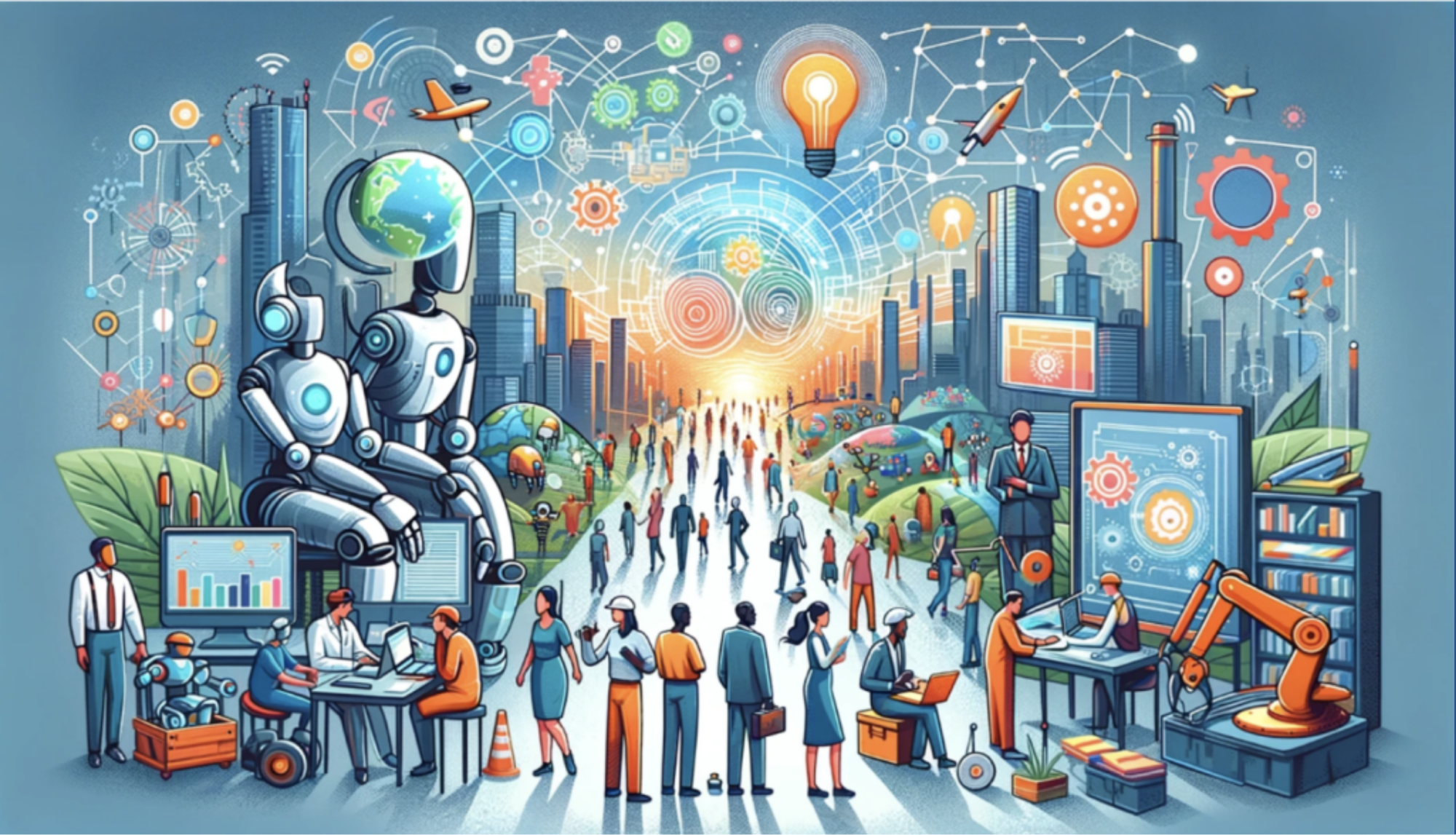
Three years is not a long time in the history of technology. Yet the period between November 2022 and early 2026 has witnessed a transformation that fundamentally changed how humans work, learn, and interact with information. What began as an experiment with a text-based chatbot has now evolved into a complex artificial intelligence ecosystem integrated into nearly every aspect of modern life.
In corporate boardrooms, university classrooms, creative studios, and even home kitchens, AI has moved from the speculative realm to operational reality. Not as a replacement for humans, but as a collaborator that expands capabilities and efficiency. This shift did not occur suddenly, but through a series of gradual innovations whose cumulative effect has been profoundly significant.
The launch of ChatGPT in November 2022 marked a turning point. For the first time, millions of people could directly interact with AI capable of understanding context, generating coherent responses, and completing complex tasks. Within weeks, the application surpassed 100 million users, the fastest growth in consumer application history. But that was only the beginning.
Multimodality: Understanding the World Beyond Text

The most significant development in the past two years has been AI’s ability to process and understand various input modalities simultaneously. Platforms like ChatGPT with GPT-4V, Google Gemini, and Claude 3 launched throughout 2023-2024 have brought sophisticated vision capabilities. These systems are no longer limited to text but can analyze images, diagrams, charts, and even screenshots with deep contextual understanding.
A retail company in Indonesia uses this technology to analyze competitor product photos from online marketplaces. The AI system not only identifies products in images but also extracts price information, reads visible reviews in screenshots, and provides competitive positioning analysis. A process that previously required a market research team for days can now be completed in hours with consistent detail levels.
In education, universities are adopting AI to provide more comprehensive feedback. Students upload their presentation videos, and the system analyzes not only verbal content but also slide quality, speaking pace, and visual aids usage. This feedback helps students develop soft skills crucial for their professional careers.
What distinguishes 2026 AI from previous generations is the seamless integration between various modalities. When someone asks about cooking by sending a photo of refrigerator ingredients, the system not only identifies individual items but understands sensible combinations, considers common cooking methods, and even adjusts to dietary preferences mentioned in previous conversations.
An e-commerce startup in Bandung uses an AI system to optimize their website conversion rate. Rather than just providing recommendations, the system proactively identifies problems in user journey through Google Analytics data analysis, conducts A/B testing for various page elements, and even generates different marketing copy variations for testing. The startup founder still makes final decisions about major changes, but most operational execution runs automatically with minimal oversight.
In the legal sector, law firms are adopting much more sophisticated AI research tools than first-generation ones. Systems like Harvey AI and Casetext’s CoCounsel can read thousands of legal documents, identify relevant precedents, and even draft comprehensive legal memos. Lawyers still conduct review and strategy, but initial research that was previously time-consuming is now effectively automated.
Crucially, these systems have learned to recognize their own limitations. When facing ambiguity or decisions requiring human judgment, they explicitly request human input rather than making potentially incorrect assumptions. This represents a more mature form of collaboration compared to previous AI generations.
Personalization in the Privacy-Conscious Era
AI personalization in 2026 faces interesting tension between the desire for customized experiences and the need for privacy protection. Regulations like GDPR in Europe and the Personal Data Protection Act implementation in Indonesia force companies to be more transparent about how user data is collected and used.
Learning platforms like Duolingo and Khan Academy have implemented sophisticated adaptive learning. These systems adjust not just content but also teaching pace and style based on individual performance. If a learner struggles with certain concepts, the system automatically provides additional explanations and more exercises before moving to the next topic. This conversion happens in real-time based on interaction patterns, not just predetermined paths.
Streaming platforms like Netflix and Spotify have enhanced their recommendation engines beyond simple collaborative filtering. Systems now consider temporal context, such as time of day, day of week, and even seasonal patterns in viewing or listening preferences. Recommendations for weekend evenings differ from commute mornings, reflecting more nuanced understanding of human behavior.
The emergence of on-device AI processing is particularly interesting. Apple’s Neural Engine and Google’s Tensor chips enable much AI processing to occur directly on users’ smartphones or laptops, without needing to send data to the cloud. This provides personalization benefits without the same privacy compromises. Features like Apple’s “Personal Intelligence” and Google’s “Private Compute Core” have become major selling points for privacy-conscious consumers.
Human-AI Creative Collaboration

Creative industries have moved past the initial phase of shock and resistance toward AI, entering a more pragmatic phase about productively integrating this technology. Tools like Midjourney, DALL-E, and Stable Diffusion have become standard workflow components for concept artists, graphic designers, and content creators.
Film studios use AI for pre-visualization and rapid scene prototyping. Directors can quickly see various visual approaches for scenes without going through expensive production processes. This does not replace cinematographers or production designers but gives them tools for more efficient creative exploration. Major studios have publicly acknowledged using AI tools in pre-production processes for some recent projects.
In the music industry, platforms like Suno AI and Google’s MusicLM enable musicians to rapidly prototype musical ideas or generate backing tracks as starting points for compositions. However, final artistic decisions, arrangements, and emotional direction remain fully under human creators’ control. Leading music producers have discussed how they view AI as tools for exploring possibilities that might not occur in traditional creative processes.
Importantly, the industry has begun establishing standards about disclosure and attribution. Major platforms now require creators to clearly indicate when AI tools are used significantly in creation processes. Discussions about copyright and fair compensation for training data are ongoing, but frameworks are becoming clearer compared to previous years’ chaos.
Enterprise Operational Transformation

about productively integrating this technology. Tools like Midjourney, DALL-E, and Stable Diffusion have become standard workflow components for concept artists, graphic designers, and content creators.
Film studios use AI for pre-visualization and rapid scene prototyping. Directors can quickly see various visual approaches for scenes without going through expensive production processes. This does not replace cinematographers or production designers but gives them tools for more efficient creative exploration. Major studios have publicly acknowledged using AI tools in pre-production processes for some recent projects.
In the music industry, platforms like Suno AI and Google’s MusicLM enable musicians to rapidly prototype musical ideas or generate backing tracks as starting points for compositions. However, final artistic decisions, arrangements, and emotional direction remain fully under human creators’ control. Leading music producers have discussed how they view AI as tools for exploring possibilities that might not occur in traditional creative processes.
Importantly, the industry has begun establishing standards about disclosure and attribution. Major platforms now require creators to clearly indicate when AI tools are used significantly in creation processes. Discussions about copyright and fair compensation for training data are ongoing, but frameworks are becoming clearer compared to previous years’ chaos.
Enterprise Operational Transformation
Enterprise AI adoption in 2026 has moved beyond pilot projects to become core operational infrastructure. McKinsey’s 2025 Global AI Survey shows 72% of large companies have implemented AI in at least one business function, up significantly from 50% in 2023.
The financial sector is the most aggressive early adopter. Large banks like JPMorgan Chase have implemented AI for fraud detection analyzing millions of transactions in real-time. These systems not only detect suspicious patterns but continuously learn from new fraud techniques, maintaining accuracy rates above 99% with decreasing false positive rates. JPMorgan reports hundreds of millions of dollars in annual savings from more effective fraud prevention.
In customer service, companies have moved beyond simple chatbots toward truly intelligent virtual agents. Klarna, a Swedish fintech company, reports their AI assistant now handles volume equivalent to 700 full-time customer service agents, with customer satisfaction scores comparable to human agents. Importantly, this frees human agents to focus on complex cases that truly require empathy and nuanced judgment.
In the logistics sector, companies like DHL and Maersk use AI to optimize routing considering not just distance but predictive factors like weather patterns, traffic predictions, port congestion, and even geopolitical risks. This optimization yields significant fuel savings and more predictable delivery times.
However, this transformation is creating significant challenges in workforce adaptation. Skills gaps are widening between workers who can effectively leverage AI tools and those who cannot. Companies are racing to implement upskilling programs, recognizing that investment in human capital is crucial for maximizing value from AI adoption.
Evolving Regulatory Landscape
2024-2025 saw crystallization of regulatory frameworks for AI in various jurisdictions. The European Union’s AI Act, passed in early 2024, began its phased implementation. This Act categorizes AI systems based on risk levels, from “unacceptable risk” that is completely banned to “minimal risk” that is largely unregulated.
High-risk applications like AI used in hiring decisions, credit scoring, or law enforcement face strict requirements for transparency, human oversight, and regular auditing. Companies deploying such systems must maintain detailed documentation about training data, model architecture, and validation procedures. Non-compliance can result in fines up to 6% of global annual revenue, creating strong incentives for careful implementation.
The United States takes a more fragmented approach, with different regulatory frameworks emerging for different sectors. The FTC has been particularly active in enforcement actions against AI systems deemed unfair or deceptive. California’s AI safety bill, though controversial, has set precedent for state-level regulation that may influence federal policy going forward.
In Asia, Singapore’s Model AI Governance Framework has become an influential template adopted or adapted by other regional countries. Singapore’s approach emphasizes principles-based regulation flexible enough for innovation yet clear enough to provide guidance.
Indonesia itself has implemented the Personal Data Protection Law adopting principles similar to GDPR but adjusted to local context. Enforcement is strengthening, with several high-profile cases against companies violating data protection requirements.
Fundamental Challenges That Remain
Despite impressive progress, AI in 2026 still grapples with several fundamental challenges not yet fully resolved.
The hallucination problem remains a significant concern. Although frequency has decreased with newer models, AI systems still occasionally produce factually incorrect information presented with high confidence. For high-stakes applications like medical diagnosis or legal advice, this remains a serious limitation. In response, many enterprise applications implement multi-layer verification systems and require human review for critical decisions.
Energy consumption from AI systems, particularly for training large models, remains problematic from an environmental perspective. A study from Stanford’s HAI indicates that training a single large language model can produce carbon footprint equivalent to several cars operating for their entire lifespans. There is significant push toward more efficient architectures and renewable energy use in data centers, but scaling up AI usage globally still raises sustainability concerns.
Bias in AI systems continues to be a pervasive issue. Despite increased awareness and efforts toward fairness, systems trained predominantly on Western data and English language still underperform for non-Western contexts, minority languages, and underrepresented populations. Research from MIT and Stanford has documented systematic biases in everything from facial recognition systems to hiring algorithms. Addressing this requires not just technical solutions but fundamental rethinking of data collection and model evaluation practices.
The alignment problem, which involves ensuring AI systems behave in ways consistent with human values and intentions, becomes increasingly urgent as systems gain more autonomy. Anthropic and OpenAI have conducted significant research in constitutional AI and reinforcement learning from human feedback, but defining and implementing “human values” in diverse global contexts remains a deeply challenging philosophical and practical problem.
Looking Forward
From the vantage point of early 2026, AI development trajectory appears simultaneously exciting and uncertain. Research labs like DeepMind, OpenAI, and Anthropic continue pushing boundaries of what is possible, but genuine Artificial General Intelligence still feels distant despite impressive capabilities of current systems.
Embodied AI is beginning to emerge from research labs into more practical applications. Companies like Boston Dynamics and Figure AI are demonstrating robots with increasingly sophisticated manipulation capabilities and ability to navigate complex unstructured environments. However, widespread deployment remains limited by factors including cost, reliability concerns, and social acceptance.
Brain-computer interfaces represent another frontier. Neuralink’s first human trials have begun, with Elon Musk announcing successful implantation in early 2024. Though still at extremely early stages, the potential for direct brain-AI interfaces raises fascinating possibilities and profound ethical questions about human augmentation and identity.
What is clear is that AI development is not a linear trajectory. There will be breakthroughs and setbacks, overhyped promises and unexpected applications. The critical task for society is navigating this transformation thoughtfully, making conscious choices about how this technology is developed, deployed, and governed. Decisions made now about regulation, research priorities, and ethical frameworks will shape whether AI becomes a force for broadly shared prosperity or exacerbates existing inequalities.
2026 is not an endpoint but a waypoint in a longer journey. AI has proven its value in countless applications, from mundane productivity tools to life-saving medical diagnostics. However, realizing full potential requires continued investment in research, thoughtful policy-making, and societal adaptation. The challenge is not just technical but fundamentally human, namely how we choose to integrate this intelligence in ways that enhance rather than diminish human flourishing.
References
- Bommasani, R., Hudson, D. A., Adeli, E., et al. (2021). On the opportunities and risks of foundation models. arXiv preprint arXiv:2108.07258.
- McKinsey & Company. (2023). The state of AI in 2023: Generative AI’s breakout year. McKinsey Global Survey.
- Bender, E. M., Gebru, T., McMillan-Major, A., & Shmitchell, S. (2021). On the dangers of stochastic parrots: Can language models be too big? Proceedings of FAccT 2021, 610-623.
- Stanford HAI. (2024). Artificial Intelligence Index Report 2024. Stanford University Human-Centered AI Institute.
- European Commission. (2024). EU AI Act: Regulation on artificial intelligence. Official Journal of the European Union.Strubell, E., Ganesh, A., & McCallum, A. (2019). Energy and policy considerations for deep learning in NLP. Proceedings of ACL 2019, 3645-3650.